
Ellisville commercial floors, coated around your hours
The hard part of a commercial floor is almost never the coating. It is the calendar. The room has to be empty long enough for the resin to cure, and cure time does not negotiate, so the whole job gets planned backward from when you can actually give us the room. Usually that means nights, a weekend, or one section at a time.
Nobody here is coating a distribution center. The commercial work in this town is small rooms that have to open again Monday.
We have been working around trading hours since 2021, and the 24 reviews on the site include the jobs we did overnight.
The commercial floors around Ellisville are small rooms, not warehouses
The older premises in the middle of town were something else before they were what they are now, and the floor usually proves it. Under the vinyl there is adhesive, under the adhesive there is sometimes a second layer of adhesive, and under all of it is a slab that has been patched by whoever needed it patched. We find that out with a test grind in a corner rather than on the day.
What they all have in common is that the business is still in the building while we are in it. These are small rooms with one way in and nowhere to put a counter, a cooler or a waiting area for a night, so the layout decides the method before the concrete does. A room you can empty gets done in one go. A room you cannot gets taken in sections, half the floor curing while the other half keeps earning.
Which leaves the real question: what hours can this building actually give us? A diner’s dead hours are not a shop’s, and in a town this size there is usually one window a week that works and no second option if we miss it. Summer humidity makes those windows longer rather than shorter, which is the opposite of what a schedule wants. Somebody also has to be back here before you open to pull tape and look at the surface, and that only works because we are not driving in from the coast.
The commercial epoxy page covers the work itself. For this one, send over the details or call 601-319-9619.
How we fit around a business that stays open
The schedule gets written first
Before anything about the floor gets decided we work out when the room can be yours to give up. Nights, a weekend, a slow Tuesday, or in sections if none of those exist. That answer changes the spec, because a faster topcoat and a sectioned layout are decisions made from the calendar, not from the concrete.
Containment before grinding
A commercial room usually has things in it that cannot leave: a walk-in, a counter, racking that is bolted down. Those get sheeted and taped off, and the extraction gets set up so the dust stays in our half of the building. On a shared wall that matters more than it sounds, because the business next door did not hire us.
A cure window does not negotiate with a schedule. Everything else on the job can.
Coving at the wall
Where the floor has to be washable, the coating comes up the wall in a curve instead of stopping at a joint. That turns the room into a sealed basin with no corner for water or grease to get behind, which is the whole reason a kitchen, a wash-down room or a kennel gets this detail and a storeroom does not.
Cure time is the one fixed thing
Everything else on the job can be moved and this cannot. The resin takes the hours it takes, and leaning on it to open early is how you get a floor that prints every cart wheel for the rest of its life. We quote the real window up front, because a window we have to break costs you more than a date you did not want to hear.
What a failed commercial floor usually tells us
Most of the commercial calls we take are about a floor that is already two or three years into disappointing somebody.
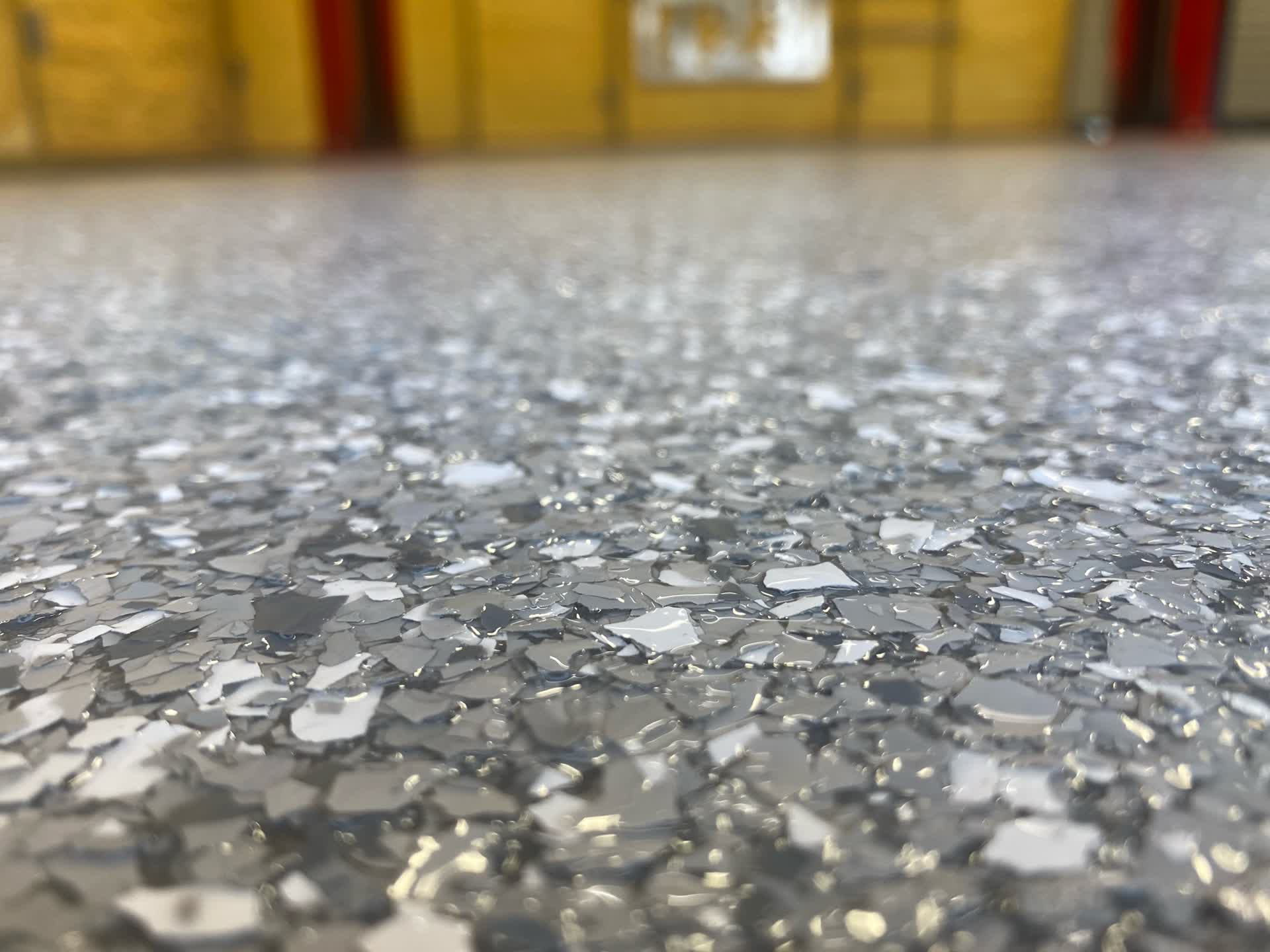
Coated in one pass over a weekend
The usual story is a crew that promised a Friday-to-Monday turnaround and delivered it by skipping the parts that take hours. One thin coat over a quick scuff, no primer, no build. It opens on time and it starts letting go at the door line inside a season, which is where the traffic and the sun both are.
No cove, so the corner failed first
In a room that gets washed down, the junction between floor and wall is the weak point, and a coating that stops square at the base of the wall leaves a seam for water to work into. We find the slab soft behind that line and the smell comes up through it. Fixing it properly means cutting back and coving.
Wrong cleaner on the right floor
A fair number of commercial floors do not fail, they get stripped. Somebody switches to an aggressive degreaser because it shifts grease faster, and over a year it dulls the topcoat into a cloudy patch wherever the mop goes most. The system underneath is still sound. The surface has been etched off it, and that is a recoat rather than a tear-out.
Specified from a square foot number
The other common failure is a floor that was quoted off an area measurement and nothing else. Nobody asked what rolls across it, what gets spilled on it, or what gets used to clean it, so the build thickness and the topcoat were both a guess. A pallet jack and a dining room do not want the same floor.
Deciding what the room actually needs
A commercial room usually has one requirement that outranks the look. In a kitchen it is that the floor and the wall meet in something a mop can actually reach. In a retail room it is grip when somebody walks in off wet concrete. In a kennel it is that nothing soaks in. On a shop floor it is whether the surface takes a dropped tool. We ask which of those is yours before anything gets specified.
The sealed floor is worth more than it looks on the quote, because the thing it buys you is an easy answer when somebody walks in with a clipboard. A junction that cannot hold anything is a junction nobody has to argue about. That is the practical reason we push coving in food and wet rooms even when the budget conversation would rather we did not.
There are four of us and no subcontractors, which on a commercial job mostly means the person who promised you an opening time is one of the four who has to be standing there over the weekend making it true. Kevin, Aaron, Kyler and Averie. Nobody passes your shutdown window to a crew that was not in the conversation. We install Duraflex systems, which matters here only because the cure windows we schedule around come from the system we are installing, not from a guess.
Where Ellisville sits for us
Working nights or a weekend in Ellisville is realistic for us in a way it would not be two hours down the road, and that is usually what a trading business needs.
The rest of what we coat in Ellisville
Used a lot of flooring companies over the years on various jobs and lemme tell you you’re in good hands with these guys. From the quote to the finished job they were nothing short of professional.Verified review
Questions we get asked
Do we have to close for this?
Not usually, but you have to be able to give us the room. Most of the commercial work here gets done at night, over a weekend, or one section at a time while the rest of the floor stays in service. Tell us your quiet hours and we build the job around them.
Can you do it in sections?
Yes, and on an open-plan room it is often the only way. We chalk the split, contain the working half and coat it out to a deliberate stop line rather than a ragged one. The joint between sections is placed where it will not be noticed, which takes a conversation first.
How much dust does the grinding make?
Less than you expect, because the grinder runs with extraction on it and the working area gets sheeted off. It is not a clean process and we do not pretend otherwise, but the dust stays in the room we are working in rather than through your stock.
Do we need coving?
If the floor gets washed down, yes. Coving runs the coating up the wall in a curve so there is no joint at the base for water or grease to get behind. In a dry storeroom or an office it is money spent on nothing. We will tell you which yours is.
What cleaner should staff use on it?
A neutral cleaner and a mop. The thing that damages a commercial resin floor fastest is somebody reaching for the strongest degreaser on the shelf every night, which slowly etches the topcoat into a dull patch. Write the cleaner on the wall by the sink and the floor keeps its gloss.
Who do we deal with on the day?
Kevin, and then the same three people every time. Aaron, Kyler and Averie run the installs with him and there are no subcontractors in the middle. On a job with a fixed reopening time that is the part that matters, because the promise and the work sit with one crew.
Tell us when the room is free
Call Kevin with the room, the hours you can give up and what gets spilled on the floor. We will come look at the slab and tell you honestly whether it fits the window you have.
Write down what the room is and we will come look at it. Finished floors are in the gallery.