
Cleary school hallways and cafeterias done in one summer
A school floor gets one real chance a year to be worked on, and that is the summer. Hallways and cafeterias take hundreds of shoes and rolling carts every day, and they drag sand in with them. We put down a flake system that hides scuffs between cleanings and needs no stripping or waxing, then phase the work so the building is ready when staff come back.
Send us the details
Schools do not close for floor work. The floor gets done when the building empties, and that sets every other decision.
Kevin Garner built ICM as a family business when he started it in 2021, and a school hallway gets the certified Duraflex install every floor of ours gets, from a crew that is Kevin, Aaron Garner, Kyler Welch and Averie Garner.
One window a year to work on the floor
Summer is the usual window, with a long holiday break as the backup for a smaller area. Other trades want the same weeks for painting, roofing and repairs, so the floor has to be on the calendar early. Tell us in the spring which areas need doing, and the order can be laid out before anyone else claims the hallways.
The building also has to reopen smelling like a school. Low odor products help, and so does running the ventilation hard while the coats cure, but the bigger lever is the order of work. We finish the areas with the least air movement first, so they have the longest to air out before anyone walks back in.
Mississippi summer humidity is the complication. A building with the air conditioning turned down for the break can hold damp air that slows every coat. We ask the facilities people to keep the system running in the areas we are working, and each slab gets a moisture test before it is coated.
The school epoxy page covers the work itself. For this one, send over the details or call 601-319-9619.
Phasing a building one wing at a time
Map the wings before anything moves
We walk the building with whoever runs facilities and split it into sections that make sense: a wing, the cafeteria, a long run of corridor. Each section gets its own days, so the rest of the building stays open to custodians and to any summer program that uses it.
Take the old finish off
Years of floor wax and finish sit on top of most school slabs and tile. All of it has to come off before a coating will bond, so the grinder runs with dust extraction across every part of the floor. That is the loud stage, and it usually comes first in each wing.
The only real deadline on a school floor is the first day back.
Cove at lockers and walls
Where the floor meets a wall or the base of a row of lockers, the coating turns up in a cove instead of stopping in a corner. Grit and mop water stop collecting in that line, and the custodian’s mop slides along it instead of catching on a vinyl base that has come unglued.
Flake that hides the day
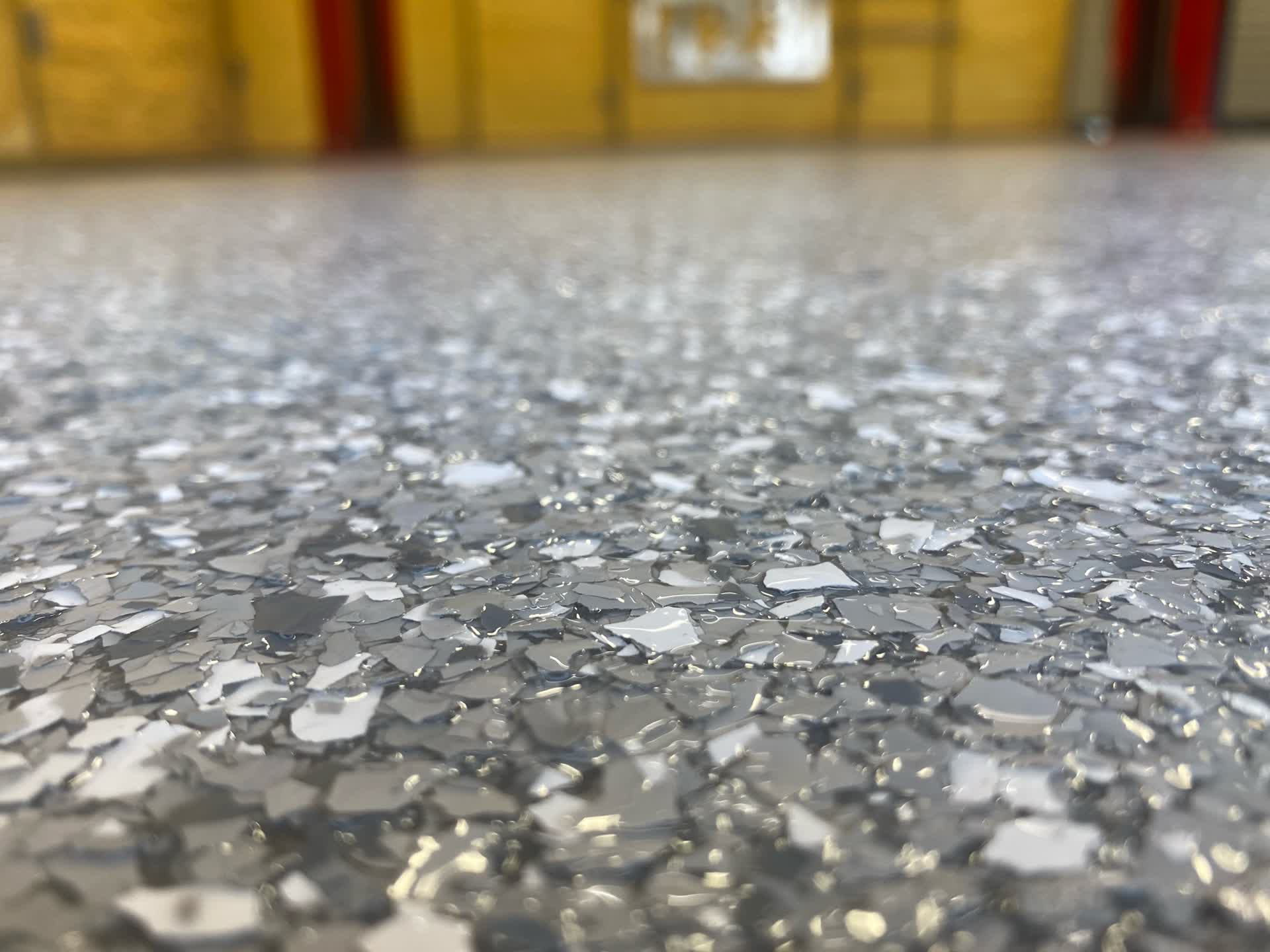
Gray and white chip blends with a third tone mixed in hide the scuffs, sand and shoe marks that build up between cleanings. A solid color in a hallway shows every one of those by lunch. The flake goes into the wet base, and a clear topcoat goes over it to take the traffic.
Why a hallway floor wears out between summers
School floors rarely fail all at once. They wear out in the busiest lanes and at every doorway, a little more each year.
The stripping and waxing cycle
A waxed tile floor looks good for a few weeks after it is redone, then the traffic lanes go dull and the cycle starts over. Each strip and recoat eats custodial time during a break that is already short. A coated floor gets cleaned and buffed, and the stripping stops.
Sand tracked in at the doors
Every entrance pulls grit in on shoes, and that grit works like sandpaper on whatever finish is down. On wax it wears dull paths into the first stretch of hallway. A harder topcoat over flake stands up to that grinding far better, and the blend hides whatever does get through.
Cart wheels in the cafeteria
Lunch carts, folding tables on wheels and the custodian’s own equipment roll the same paths every day. On a soft finish they leave tracks and, over time, wear through. The cafeteria gets a build chosen for rolling loads and wet spills, a different spec from a classroom corridor.
A gap at the locker base
Lockers often stand on a raised base, and the joint between that base and the floor collects dirt and water. If the coating stops short there, the edge lifts and the line turns black. Carrying a cove up to the base keeps that joint sealed and easy to mop.
Getting the floor done before staff come back
Most of this comes down to the calendar. We need the day the building closes, the day teachers return and any weeks in between when part of the building is in use. With those dates the job gets split into phases, and each wing is given enough time to cure before furniture goes back onto it.
Furniture is its own task. Hallways are simple, but the cafeteria and any classrooms in the job need tables, chairs and equipment moved out and kept off the floor until it is ready. Whoever handles that over the summer needs our phase dates, so nothing gets rolled back in a day early and leaves marks in a soft coat.
Cafeterias get their own plan. Tables and chairs drag across that floor every lunch, milk and ketchup land on it daily, and the kitchen side usually wants more grip than the dining side. We treat it as two zones on one system, with the change in texture put where the serving line ends.
Where Cleary sits for us
Cleary is a Rankin County town inside the area we cover out of Laurel, and a school floor there gets planned months ahead of the summer it goes down in.
The rest of what we coat in Cleary
Choosing somebody to do our Floors was a hard decision but I am so happy we picked ICM coating masters. The results are beautiful and The time and effort put into the work was amazing.Verified review
Questions we get asked
Can the whole floor be done over one summer?
In most buildings, yes, if the planning starts early. We split the job into wings or areas and work through them in turn, so every section gets its full cure before staff return. If a building is too big for one break, we would rather tell you that in the spring.
Do coated floors still need waxing?
No. A coated floor gets regular cleaning and a buff now and then, and the strip and recoat cycle stops. That frees custodial time over breaks for other work. The topcoat is what takes the wear, so there is no finish layer to keep rebuilding.
Will the building smell when it reopens?
We plan the work to avoid that. The products we use in schools are low odor, fans and the building’s own system keep air moving through each wing during the cure, and the stuffiest rooms go first. Everything is scheduled around the day staff walk back in.
What happens around the lockers?
The coating turns up in a cove at the locker base and along the walls, so there is no corner for grit and mop water to collect in. If any lockers need to come off for the work, we sort that out with facilities before that phase starts.
Can you coat over the old tile?
Sometimes. Well bonded tile can be ground and coated once all the old wax is off. Tile that is loose, cracked or curling at the edges needs to come up first. We look at it during the walk through and tell you which areas can stay as they are.
Can part of the building stay open?
Yes, which is the whole reason for phasing. Custodians, summer programs and office staff use the areas we are not in, and each section is closed off while it is ground and coated. We agree on the order with facilities before the first day.
Get the summer on Kevin’s calendar in spring
Call Kevin with the areas you want done and the dates the building closes and reopens. He will walk the hallways and the cafeteria, look at what is under the wax, and come back with a phase plan that fits your break.
Have a look at the gallery, then get the details over to us.