
Ellisville metallic floors, poured one at a time
Metallic is not a color you pick off a chart and receive. It is pigment moved through wet resin by hand, so the pattern happens on the floor on the day, and the floor you get is the only one that will ever look exactly like it. Most people love that. A few people need to hear it out loud before they commit.
Send us the details
This is the one finish where the room matters more than the slab.
Metallic is the finish people recognize us for, and it is the one we are slowest to recommend if the room is wrong for it.
Which Ellisville rooms a metallic floor belongs in
A metallic floor nearly always goes into a room that is already finished. A front room, a dining room, a basement that became living space. What those rooms have in common is that people stand still in them and look down. A garage floor gets judged at walking speed on the way to the car. This one gets looked at from a chair, and that is why we grind these further than anything else we install.
Daylight is the part people forget to account for. A metallic floor is a different floor at nine in the morning than it is at five, and a room with one window reads nothing like a room with glass down two sides. Movement that looks deep under a lamp can flatten right out in flat afternoon light. Same floor, different light. Which is why the room you are putting this in decides more about the result than the blend does.
Working inside a finished room is its own job, too. Baseboards to protect, a doorway sealed so the grinding dust does not travel through the house, a tile line to finish against, furniture that has to live somewhere for a day and a night. None of that is hard and all of it goes easier sorted before we arrive. The one thing we will not move is the start time: a humid afternoon shortens the window the resin stays open, and a shortened window shows in the pattern.
The metallic epoxy page covers the work itself. For this one, send over the details or call 601-319-9619.
What pouring a metallic floor involves
The grind has to be flatter than usual
On a flake floor the broadcast layer hides small variations. On a metallic there is nothing between your eye and the concrete except clear resin, so the grind goes further and the flat-work matters more. High spots come down, repairs get blended rather than just filled, and the whole floor gets checked under a raking light before anything is mixed.
Pigment goes in while the resin is open
The base goes down and then the metallic is worked into it by hand while it is still moving. That is the part that cannot be undone or adjusted later. Whoever is holding the tool is making the pattern in real time, reading the floor as it flows, and the room has to be closed and still while it happens.
The pattern is made on the day, once, and it is never made the same way twice.
Nothing walks on it until it is hard
A wet metallic surface records everything. A footprint, a dropped tool, a pet that got through a door nobody latched. We close the room off properly and we would rather lose an hour taping a doorway than find a paw print set into the middle of a finished floor. The 12 hour walk-on window is not a suggestion on this one.
Topcoat decides how long it looks new
The clear coat over a metallic is doing more work than it does on a textured floor, because it is the only thing between the pattern and the world. It takes the abrasion, it takes the light, and it is what you are actually cleaning. Walk on it at 12 hours, heavy furniture back at 24.
The ways a metallic floor disappoints people
Metallic goes wrong differently from the other systems. Usually the resin is fine and the expectation was never set.
It does not look like the photograph
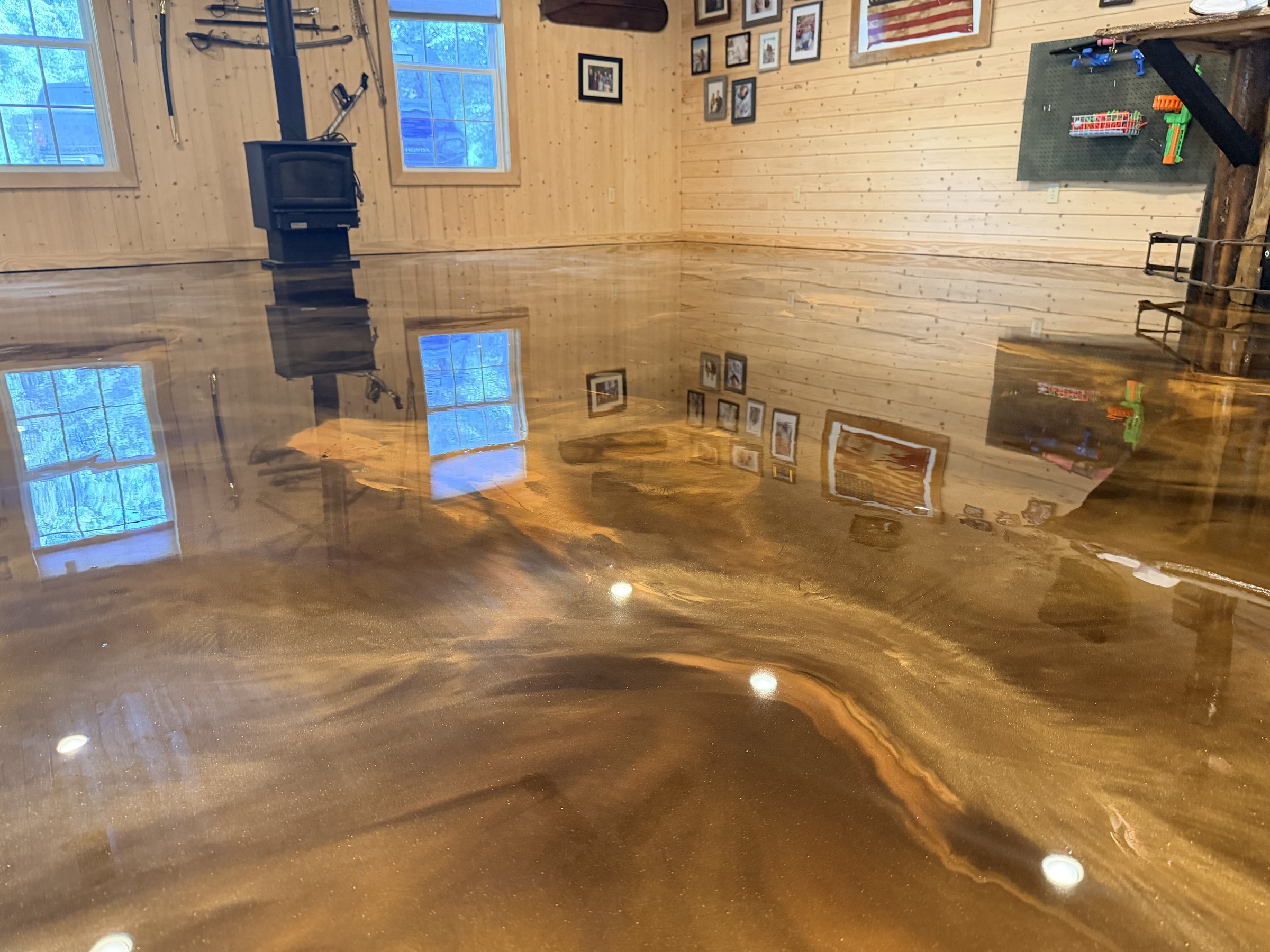
This is the big one. Somebody saw an image online, bought the same pigment, and got a floor with its own pattern, because that is what the system does. We show finished floors so you can see the character of a blend and the range it works in, and we say plainly that your floor will be its own thing.
Poured over a slab that was not ready
A metallic poured over a slab that was not properly ground looks worse than the same shortcut under flake, because the gloss magnifies every flaw instead of texture breaking it up. We get called to floors where you can still read the old tile grid through the finish, and there is no fixing that from the top.
Put in a room that wanted texture
A smooth gloss floor is slicker underfoot when it is wet than a flake or quartz build, and it shows scuffs sooner. In a front room or a showroom that is a fair trade. At the top of a basement stair, in a mudroom, or anywhere people come in off rain, it is the wrong choice and we will say so.
A clear coat that went yellow
Not every clear topcoat stays clear. Some amber noticeably inside a year under indoor light, which on a cool gray metallic turns the whole floor a shade nobody asked for. That is a product choice made on price, and it is one of the few metallic failures that is entirely invisible until it is done.
How to decide on a finish you cannot see first
What we can show you is the palette and the behavior. A swatch tells you the colors in play and roughly how much contrast the blend carries. Finished floors tell you what that blend does across a whole room, where it pools light and where it goes quiet. What nobody can show you is the exact pattern your floor will land on, because it does not exist until the resin is on it.
The decision worth spending time on is contrast, not color. A high-contrast blend is dramatic in a big room with good light and overwhelming in a small one. A quieter blend reads as depth rather than pattern and lives better under furniture. Think about how much of the floor will actually be visible once the room is furnished, because that changes the answer more than the palette does. We bring the swatch out to the room so you are judging it under the light it will actually live in.
Underneath it all there is one question only you can answer: are you ready to commit to a floor that does not exist yet? Some people hear that and they are in immediately. Others want to stand on a finished one in a real room before they decide, which is the right order for them, so we arrange it instead of talking them past it. A floor somebody agreed to reluctantly is a floor they notice for the wrong reason every day.
Where Ellisville sits for us
A metallic pour wants an unhurried day and a second visit to look at it in daylight, both of which are easy this close to home.
The rest of what we coat in Ellisville
Aaron and his crew did a fantastic job, friendly and professional.Verified review
Questions we get asked
Will my floor look like the picture I found?
No, and nothing can make it. The pattern forms while the resin is open and it is different every time, which is the point of the finish. The blend and the contrast level carry over from the picture. The exact movement does not, and anybody promising otherwise is guessing.
Is metallic less durable than flake?
The system underneath is the same build, so the wear resistance is comparable. What differs is how it shows its age. A smooth gloss picks up fine scuffs and scratches that a textured flake floor hides completely, so the same amount of wear looks like more on a metallic.
Can you put it in a garage?
You can, and we mostly talk people out of it. A garage brings in grit and water, both of which a smooth gloss shows immediately and a flake blend absorbs visually. Metallic earns its keep in a room people stand in and look at rather than park in.
Does the slab need more preparation for this?
Yes, more than for any other finish we install. A gloss surface magnifies whatever is underneath it instead of breaking it up, so high spots, float marks and old repairs all have to be ground out rather than coated over. The prep bar goes up, not down.
Is it slippery?
Dry, no more than any hard floor. Wet, yes, more than a flake or quartz build, because there is no texture in the surface. That is why we ask what comes into the room before specifying it, and why adding grip to the topcoat is sometimes the right answer.
How long does it take and when can we use it?
A typical residential room is a single day on site. Walk on it at 12 hours, move heavy furniture back at 24. Nothing comes into the room while the resin is open, so clearing it properly beforehand saves more time than anything else you can do.
See a real one before you decide
Call and describe the room. Kevin will come look at the slab, tell you honestly whether it suits a gloss finish, and show you floors we have poured so you know what the blend actually does.
The gallery is the honest version of what we do. Send us the room and we will take it from there.